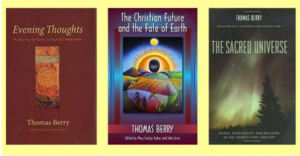
Discoveries Made Upon Re-Reading Thomas Berry’s Later Books

This is a re-post from The Ecozoic Review, April 2019, a publication of the Center for Ecozoic Studies in Chapel Hill, NC.

The essay by Herman Greene is called “The Long View: Thomas Berry’s Instruction on the Reform of Religion, Law, and Culture in His Later Books” (Evening Thoughts, The Christian Future and the Fate of Earth, The Sacred Universe) and can be read here in full.

I share the essay with you because of my experience while reading it: Herman’s synthesis activated new rooms of understanding and expanded awareness in my heart/mind/soul/psyche for what Thomas was trying to express and the way forward that he was pointing, the same way a first reading of Thomas can open you up and blow your mind. There are many quotes from Thomas but Herman’s voice adds important insights. He writes:

These later books, I had thought, were a recapitulation of those ideas, with the exception of the part on Earth jurisprudence. I hadn’t given these later books much attention.

I have a different view of them now. They do largely concern ideas covered in the earlier books, but they do so in a substantially different way. The later books are not just afterthoughts, an archive of additional materials of Berry. They were and are needed for the completion of his work. They are passionate appeals to the religious and legal communities, indeed to all of us, to take action with specific instruction on what they and we are to do. I felt like Berry said in these books, “This is what I meant. You must understand what I’m writing here and do what I say here or the Great Work will fail!”

Continue reading here (scroll down to begin the essay on page 4).


Posted in Uncategorized | Comments Off on Discoveries Made Upon Re-Reading Thomas Berry’s Later Books

Notre-Dame de Paris and A Place Deeper than Words

by Sheri Ritchlin, PhD

SheriRitchlin.com

Flames and smoke rise from the blaze at Notre Dame Cathedral in Paris. Photograph: Thierry Mallet/AP

Yesterday several people interviewed by the media said they were surprised by their own response to the news that Notre Dame was on fire. They burst into tears (as I did). They were not French. They were not religious.

In a world filled with inflamed rhetoric like a huge bowl of ire, this was an event that took us to a place deeper than words. It was like 9/11 or in my lifetime, the news of Kennedy’s assassination. How important this is to remind us that we are beings who have such places below words, who are made of an unconscious fabric that connects us, not only with people throughout the planet in the present time, but to a thousand years of history in the past, and long before that.

Caught as we are in the tangled mesh of political, philosophical and theological concepts–none of which can be universally “agreed” upon–as Allysyn Kiplinger says, we should consider what this moment is saying. (Read her blog post from yesterday about Notre-Dame here.) The day before Notre Dame burned, a headline in New Scientist above a photo of one of last year’s massive forest fires, read “BBC climate doc adviser: Earth is sending us really powerful messages.” The documentary, Climate Change – The Facts, will be presented by David Attenborough. Perhaps the flames of Notre Dame, on the Monday of Holy Week, are sending us a message too.

Last night on the PBS Newshour, the images of destruction from Paris were followed by the images of a US town’s destruction from a tornado. The woman who had seen her home ripped from its foundations had no words for that either.

During the immediate aftermath of 9/11 Beethoven’s 9th Symphony was summoned to voice a collective international mourning. When the original performance ended, Beethoven had to be turned around to see the cheering audience. He was completely deaf. It seemed appropriate, though not intentional, that the Newshour ended with Yoyo Ma playing Bach on both sides of the Mexican Border; music going to those deeper places where walls cannot exist.

Humans are described as being separated from the animals by our intelligence, our capacity for reflection and the power of language. Artificial intelligence is advancing with lightning speed and is predicted to equal or even surpass us in those powers. Ironically, what will distinguish us from artificial intelligence is the immediacy of our sentience, which we share with other creatures, and the ground of sympathy with all creation that makes us receptive to the messages of Earth and History, which remind us of who we are. Let us hope that this human is the “programmer.”

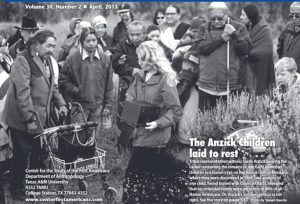
In the photo below, note the expression on the face of the little boy (right) as his mother, Sarah Anzick, is about to rebury the remains of a child unearthed on their property after his original burial 12,600 years ago. DNA revealed that his family were the ancestors of 80% of all native groups in North and South America. Around them are members of tribes from Washington, Oregon and Montana. This is 175 miles from my home.

Shared humanness. Deeper than words.

Posted in Uncategorized | Comments Off on Notre-Dame de Paris and A Place Deeper than Words

Overthrow Our Life-Denying System

From The Guardian, April 16, 2019

Only rebellion will prevent an ecological apocalypse

by George Monbiot

The last paragraph:

“Today, Extinction Rebellion takes to streets around the world in defence of our life-support systems. Through daring, disruptive, nonviolent action, it forces our environmental predicament on to the political agenda. Who are these people? Another “they”, who might rescue us from our follies? The success of this mobilisation depends on us. It will reach the critical threshold only if enough of us cast aside denial and despair, and join this exuberant, proliferating movement. The time for excuses is over. The struggle to overthrow our life-denying system has begun.”

Full article: https://www.theguardian.com/commentisfree/2019/apr/15/rebellion-prevent-ecological-apocalypse-civil-disobedience

Posted in Uncategorized | Comments Off on Overthrow Our Life-Denying System

Notre-Dame de Paris Self-Immolates to Save the West from Itself

There is a long history in many religious and ethical systems of sacrifice, self-sacrifice, self-immolation, martyring one’s self to take a stand, make a point.

I sense Notre-Dame de Paris self-immolated today in order to serve as a metaphor to bring the western world together, to remind us of our historical journey these last 859 years, and to assist us as we move forward to become a loving Earth community.

One friend wrote that buildings do not self-immolate. I’m not so sure.

Geneen, a friend in Utah, wrote, “Our Lady ignites our attention and pondering of the mysteries [of life], and [with] unexpected, public devotions and grief.”

On the evening of Monday, April 15, 2019 Our Lady huffed and puffed and burst herself into flames just minutes after closing when the last of her visitors had safely left for the day. She made sure everyone was safely out of the building. It reminds me a bit of what Thomas Berry said about the World Trade Center in New York City. If it were ever destroyed he hoped it would happen on a Sunday morning when no one was in the buildings. Always keep the people safe.

Art historian Lord Kenneth Clark opened his 1969 book and accompanying documentary “Civilisation” in front of Notre-Dame de Paris asking “What is civilisation?” (pg. 1). He believed that Notre-Dame de Paris represented it in some ineffable way.

My friend Siddika just called to share her sadness about the cathedral’s fire. She felt it was a metaphor for the fact that western civilization is on fire, destroying itself. That is true, of course. Later she added,

I had a further thought about the Western Civilization on fire motif. The towers, essential  to Notre Dame, remain. They are the moral foundations of the West, the true distilled wisdom of the earth’s great Western religions: love; do unto others as you would have them do unto you; be merciful; care for the stranger and the vulnerable; feed the hungry; care for the sick; forgive (even enemies). From these towers of ethics we will have to rebuild our world if we are to survive as a race worthy of the name Homo sapiens rather than be consumed by the fires of climate change, hatred, and war.

And speaking of hatred and war, maybe it is no accident that the color of our current president’s hair is the color of fire, and that we say about him what we said to kids on the elementary school playground, “Liar! Liar! Pants on fire!”

Resurrection by Brian Sebastian Swimme, the son of Brian Thomas Swimme

Brian Thomas Swimme framed the fire as the mystery of death in this post in the Journey of the Universe newsletter entitled “Resurrection”:

The world watched in horror as some of history’s most beautiful works of religious art became flame, then smoke, then atmosphere. Stunned to our bones, again, by the mystery of death.

Only in the rarest places, including the poetry of our most profound mystics as well as the ravings of our saddest lunatics, is death admired. Our fear reveals our intense love of our fragile lives. Even pyramids fail as bargaining chips.

Though the universe has been creating itself for fourteen billion years, only recently has any Earthling pulled back the blanket of time to contemplate the whole. We are astounded to discover the ways the universe thrives on death. Ninety-nine percent of all the species Life has concocted have gone extinct.

We do not have words for the fire that destroyed Notre Dame forever. We shiver when we hear St Francis call holy the burning firebrand pressed to his eye. Or the French Jesuit Pierre Teilhard de Chardin discovering, at the front of war, the Cosmic Christ. But they force us to wonder. Does the universe have the creativity to turn our dread into astonishment as something new, something erotic, something death-defying comes forth?

I just talked to another friend about the fire in Paris. She is not someone prone to the metaphysical so for me her words carry extra weight. She said that upon hearing of the fire she glimpsed a vision, a mythical image, of a phoenix rising from the ashes of the cathedral. Perhaps western civilization reborn?

Here is an illustration from the past to give hope and direction for the future. It’s by Jean Fouquet from about 1450 and depicts the cathedral of Notre-Dame, already nearly 300 years old, with the rest of Paris in the background. It is proof that there once was wild nature on the banks of the Seine. May it be so, again, under the graceful guidance of Our Lady for Our Earth.

Posted in Uncategorized | Comments Off on Notre-Dame de Paris Self-Immolates to Save the West from Itself

Thomas Berry’s Brother

This arrived in an email this morning and I thought it was important enough to share it with you. Jim Berry and Thomas Berry might be seen as co-articulators of the ideas that have come to be associated with Thomas Berry. Jim Berry was a power-house in his own right – a strong clear voice for Earth.

Jim Berry

“Humans belong to the Earth and to Earth’s life system; are part of it and have the clear obligation to honor the Earth and to behave in such a way as to demonstrate that honor. You are urged to love your country, but your love of the land, of the trees and the animals and the life-giving photosynthetic process is about a million times more important than nationalistic love of political and economic and social entity doing a whole lot of bad things. ” ~ James Fant Berry

We of (the) Center for Ecozoic Societies will remember Jim for his work through the Center for Reflection on the Second Law. From March 1980 through June 1998, Jim sent out letters, which he called circulars, every month, 181 in all. Being only two pages long these were avidly read. He wrote about human-Earth relations and the teachings of his brother, Thomas Berry. People said he could explain Thomas better than Thomas could. Copies of his 181 circulars are available here and may be read and distributed freely under a Creative Commons  Attribution 3.0 Unported License.

Jim nourished many environmentalists, young and old, through annual retreats at Camp New Hope outside Chapel Hill, NC.  The subjects were always the same–we need to care for Earth. Many outstanding people spoke, lively workshops were held, and there was always a campfire in celebration of ancestors.

Perhaps nothing captures Jim better than the way he would stand up in public meetings and with his booming voice preface his remarks by saying “I SPEAK FOR THE EARTH!”

Jim Berry in front of The Red Oak at his brother Thomas Berry’s Riverdale Center in Bronx, New York

Obituaries:

We celebrate the life of James Fant Berry.

His work, his kindness, and his passion for Earth lives on.

Posted in Uncategorized | Comments Off on Thomas Berry’s Brother

Indigenous Resistance: The Big Picture behind Pipeline Protests

Cultural Survival Quarterly Magazine  – March 2017

US pipelines

Last fall, Indigenous Peoples from around the world came to stand with Standing Rock on the banks of the Cannonball River in North Dakota to protect water through the power of prayer, occupation, and protest. Standing Rock has become a much bigger symbol for the ongoing disregard of Indigenous rights to traditional territories and ways of life.

Tara Houska (Couchiching First Nation), national campaign director for Honor the Earth, described what happened at Standing Rock at the October 2016 Indigenous Forum, hosted by Bioneers: “The stories are the same no matter where you go around the world with Indigenous people. It’s always this extractive project contaminated our drinking water; this industry is preventing us from exercising our rights to hunt and fish; our traditional foods are dying; our children are sick; our elders are sick; we have cancer clusters. Standing Rock has become for Indigenous people this moment where they’re all standing together because they all know what happens when something like this is allowed to happen to them and to their communities.”

Tears of joy after the U.S. Army Corps of Engineers pulled the project permit in December were replaced with tears of anguish in January when President Trump issued an executive action to steamroll ahead with the pipeline as part of the administration’s aggressive pursuit of a fossil fuel-based national economy. As of February 2017, water protectors are still fighting for the health and safety of all Americans, including those yet to be born, who will suffer ill-effects of this pipeline.

Across North America, pipelines have resulted in massive disruptions to ecosystems. Contamination from extraction practices have resulted in increased health problems, including birth defects and cancers among people and animals. Indigenous women have been beaten, raped, and killed by transient construction workers and black economy criminals that surround the extraction industry. CEOs give orders to deliberately demolish burial grounds and sacred sites, and those who resist are met with rubber bullets, tear gas, attack dogs, bright lights, and cold waterboarding. In any other context these flagrant displays of human rights violations would be tried as domestic terrorism.

continue reading…


Posted in Uncategorized | Comments Off on Indigenous Resistance: The Big Picture behind Pipeline Protests

The Great Acceleration

Global Change – International Geosphere-Biosphere Programme (now known as Future Earth since November 2015) – approx 15 January 2015

Great Acceleration 2015 from International Geosphere-Biosphere Programme

The second half of the 20th Century is unique in the history of human existence. Many human activites reached take-off points sometime in the 20th Century and sharply accelerated towards the end of the century.

The last 60 years have without doubt seen the most profound transformation of the human relationship with the natural world in the history of humankind.

The effects of the accelerating human changes are now clearly discernible at the Earth system level. Many key indicators of the functioning of the Earth system are now showing responses that are, at least in part, driven by the changing human imprint on the planet. The human imprint influences all components of the global environment – oceans, coastal zone, atmosphere, and land.

Dramatic though these human-driven impacts appear to be, their rates and magnitudes must be compared to the natural patterns of variability in the Earth system to begin to understand their significance.

The increase in atmospheric carbon dioxide concentration provides a useful measure with which to evaluate the rate and magnitude of human-driven change compared to natural variability. The human imprint on carbon dioxide is unmistakable. In December 2014, atmospheric carbon dioxide concentration stood at 399 parts per million by volume (ppmV), over 100 ppmV above the previous maximum level of around 280 ppmV recorded in the Vostok ice core.

Within the current limits of resolution of the ice-core records, the present concentration has been reached at a rate at least 10 and possibly 100 times? faster than carbon dioxide increases at any other time during the previous 420 000 years. Thus, in this case human-driven changes are well outside the range of natural variability exhibited by the Earth system for the last half-million years at least.

Over just the past few hundred years, human activities have clearly evolved from insignificance in terms of Earth system functioning to the creation of global-scale impacts that:

• are approaching or exceeding in magnitude some of the great forces of nature

• operate on much faster time scales than rates of natural variability, often by an order of magnitude or more

• taken together in terms of extent, magnitude, rate and simultaneity, have produced a no-analogue state in the dynamics and functioning of the Earth system.

continue reading…

Posted in Uncategorized | Comments Off on The Great Acceleration

A new era dawns and it won’t be human-friendly – will it?

By Kieran Cooke – Climate News Network – March 31, 2017

dinotude / CC BY 2.0

Human mistreatment of the planet is ushering in another era and it is not going to be pleasant, according to Clive Hamilton’s latest book.

LONDON, 31 March, 2017 – Clive Hamilton’s book Defiant Earth – the fate of humans in the Anthropocene is not for the faint-hearted. Basically, its thesis is that the Earth – and us along with it – is going down the tubes.

Our rampant, irrational use of the planet and its resources, including our exploitation of climate-changing fossil fuels, means we are interfering and upsetting the functioning of the Earth system that sustains us.

“This bizarre situation, in which we have become potent enough to change the course of the Earth yet seem unable to regulate ourselves contradicts every modern belief about the kind of creature a human being is,” says Clive Hamilton, professor of public ethics at Charles Sturt University in Australia.

Dramatic destruction
We – the post World War Two generations – have a lot to answer for. Yes, the trouble can be traced back to the 18th century when the Industrial Revolution began in Britain and factories started spewing carbon emissions into the atmosphere.

But the pace of change and the destruction of much of the Earth system has dramatically speeded up over the last 70 or so years – a period referred to as the Great Acceleration.

A dizzying surge in global economic growth, along with resource exploitation, loss of diversity, including the extinction of numerous species and ever-increasing waste volumes, have brought about a profound transformation of the human relationship with the natural world, says Hamilton.

The Holocene period in the Earth’s history – the 10,000-year epoch of mild and constant climate that has permitted civilisation to flourish – is at an end.

“Experts are already suggesting that the changes caused by humans in recent decades are so profound and long-lasting that we have entered not a new epoch but a new era – the Anthropozoic era – on a par with the break in Earth history brought by the arrival of multicellular life,” Hamilton says.

read more…

Posted in Uncategorized | Comments Off on A new era dawns and it won’t be human-friendly – will it?

The veins of America: Stunning map shows every river basin in the US

By Cheyenne Macdonald and Mark Prigg – Dailymail.com – 21 October 2016

Created by Imgur user Fejetlenfej , a geographer and GIS analyst with a ‘lifelong passion for beautiful maps,’ it highlights the massive expanse of river basins across the country – in particular, those which feed the Mississippi River, in pink

A stunning new map shows the complex network of rivers and streams in the contiguous United States.

Created by Imgur user Fejetlenfej, a geographer and GIS analyst with a ‘lifelong passion for beautiful maps,’ it highlights the massive expanse of river basins across the country – in particular, those which feed the Mississippi River.

The map visualizes Strahler Stream Order Classification, the creator explains, with higher stream orders indicated as thicker lines.

It was created using the open-source QGIS software, and the high resolution prints are available on Etsy.

There are 18 major river basins in the 48 states of the contiguous US, but much of the map is dominated by the massive catchment area for the Mississippi River, including the Upper and Lower Mississippi River Basins, along with Missouri River Basin and the Arkansas-White-Red Basin, as seen in pink.

The top left portion of the map shows much of the Pacific Northwest basin, illustrated in a brownish-orange color.

And, the Upper and Lower Colorado River basins stand out as well, in bright yellow.

read more and see more maps…

Posted in Uncategorized | Comments Off on The veins of America: Stunning map shows every river basin in the US

Living world: Should natural entities be treated as legal persons?

by Kurt Cobb – Resource Insights – April 09, 2017

This year the New Zealand parliament voted to give legal personhood to a river and provided for the appointment of two guardians to represent it. In India a court extended legal personhood to the Ganges and Yamuna rivers and the glaciers that feed them.

It defies our normal modes of thinking that natural entities such as trees, rivers, mountains, lakes, and glaciers should be given legal standing in courts and public life. And yet we take as a matter of course the legal rights of other inanimate entities:
The world of the lawyer is peopled with inanimate right-holders: trusts, corporations, joint ventures, municipalities, Subchapter R partnerships, and nation-states, to mention just a few. Ships, still referred to by courts in the feminine gender, have long had an independent jural life, often with striking consequences.

The quotation comes from a famous law review article on the topic of rights for natural entities entitled “Should Trees Have Standing? Toward Legal Rights For Natural Objects,” written in 1972 by Christopher Stone, a professor of law at the University of Southern California.

Perhaps our most important blind spot is that we forget that we humans are natural entities as well. Scientists study our bodies just as they do the bodies of other animals–except that these scientists are not allowed to kill humans to dissect them or expose them to potentially harmful substances without informed consent. (Animal rights activists would argue that such protections should be extended to all animals.)

Ultimately, what’s at stake is what our relationship with other natural entities will be and whether it is in our interest to grant them legal rights. It is well to remember that full legal rights for women, African-Americans, Native Americans, the mentally and physically disabled, and many other disadvantaged groups were once unthinkable, too. And yet, today few would argue against including these previously excluded groups within the realm of legal personhood.

But, one might say, these are people and belong to a special category. Nature cannot speak for itself as we humans do. To which law review author Stone replies:

It is not inevitable, nor is it wise, that natural objects should have no rights to seek redress in their own behalf. It is no answer to say that streams and forests cannot have standing because streams and forests cannot speak. Corporations cannot speak either; nor can states, estates, infants, incompetents, municipalities or universities. Lawyers speak for them, as they customarily do for the ordinary citizen with legal problems.

Now, perhaps the most important phrase in the above quotation is “in their own behalf.” This explains why we might not regard it as sufficient merely to compel people by law and by custom to take care of natural entities. When natural entities do not have independent advocacy, it is all too easy to consider them merely as the instruments of humans. We call them “resources” and that means they are for our use as we please. Nature becomes merely a great vat of primordial clay from which we humans can take whatever we want and shape it to our needs without regard to the needs of any other entities.

read more…

Posted in Earth Jurisprudence | Comments Off on Living world: Should natural entities be treated as legal persons?