Stay turned for news of the May 2014 Thomas Berry Colloquium at the University of North Carolina, Chapel Hill.
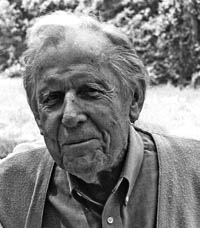
Thomas Berry (1914 – 2009)

[For Calliope]
My daughter leapt into the world
After nine months of uterine back flips
(and back pain)
Writing graffiti
on the walls of her womb
Head-first-diving into life
like a supernova.
*
My daughter dove into existence
on a day when all over the world
people were dying before they lived
not paying attention to their wide, wondrous world.
She cried out to them
(I heard her)
Wake up! I am here!
*
My daughter brought forth her world on a day like any other:
the wide, soft earth cried out beneath the suffering of her children
who–some of them–took their blink-of-an-eye existence & danced upon suffering
singing Calliopean songs of rebirth.
Even on the day her father tearfully called his mother
sitting by his brother’s deathbed.
We needed some good news, she said.
*
My daughter brought forth an entire universe
from her speck-of-dust soul–
We had waited so long for her:
Since the day I saw her mother,
on that porch,
drinking homemade wine
So many years ago
*
Since the day when I watched my own little brother
(my daughter will do better than I did)
come home from the hospital
Since the days when the ancestors wandered over seas and mountains
to lose themselves
and to find
Each other.
*
Still longer, we have waited:
Since the days when the entire universe was written
in a single book
–the original speck-of-dust–
& danced its dance, sang its song
& wrote its new poem: stars pressed across the sky
(is this what you painted on the walls of your womb?)
*
& now, you are here:
Like the rest, you will get only a blink of an eye
(I cannot lie)
but we’ve waited for you so long
to sing your Calliopean song.
We needed some good news:
& you are it.
September 18, 2013
From the website of a student of Brian Swimme’s; https://theodorerichards.com/http:/theodorerichards/the-day-my-daughter-was-born-part-ii-a-gestational-epic
Let’s have a civilization that celebrates a different creature every day! Can you imagine – nothing but a constant world wide party as we dance and sing and celebrate ALL the creatures and their role in our Earth community. It could be like the Indian Festival of Color – all the time!

or… A world without elephants?

I was in a “SoulCollage” workshop last week where a gal was mesmerized by a close-up photo of the happily-twised trunk of an elephant. She chose the image to represent her spiritual teacher from whom she had received many gifts. Will future generations know the embodied and spiritual gifts of our elephant companions?
In the mutually enhancing world of the Ecozoic all species have the right to habitat and to participate and contribute to the Earth community.
Celebrate World Elephant Day, August 12! Have an elephant party?
Short article at ENN: https://www.enn.com/top_stories/article/46308
Long article at the website of World Elephant Day: https://worldelephantday.org/about
Satish Kumar, Editor in Chief at Resurgence / Ecologist magazine of England, favors the word Ecozoic over Anthropocene to better describe our current moment. His cover story and editorial from Issue 279 • July/August 2013 is copied and linked below. Thank you to Dr. Mary Evelyn Tucker for bringing the article to our attention at the Sophia Center Summer Institute 2013.
https://www.resurgence.org/magazine/article3937-the-ecozoic-era.html
The first principle of ethical and ecological living is to live in harmony with oneself, with the fellow members of the human family, and with all the species of the Earth community. Unfortunately, rather than living in harmony, the industrial societies have been busy controlling, dominating and reshaping the natural world to suit the industrial design and financial greed of modern civilisation. Now it is being proposed that we should name our age ‘the Anthropocene epoch’, meaning ‘the age of Man’.
The Nobel Laureate Paul Crutzen, who proposed this new name, has very good intentions. He believes that by highlighting human centrality and the impact of human activities upon the natural world we might wake up and do something to save the planet; we might develop a new sensibility for sustainability. However, many ecologists and environmentalists are worried about this proposal and are asking a fundamental question: by naming a geological epoch after ourselves are we not committing the ultimate act of human arrogance?
There is a reason for such questioning. Human hubris has been in evidence before – even when intentions may have been good. For example, the Whole Earth Catalog once proclaimed that we are “as gods and might as well get good at it”. And more recently, Mark Lynas named the human species “the god species”.
One way or another the industrial societies possessing powerful technologies have come to believe that they can and have conquered Nature. Now Nature must be managed, manipulated and even looked after – but only so that it can better serve the ever-increasing demands of industrial societies.
In this context even the well-intentioned idea of anthropocene could prove to be dangerous. Writing in the Spring 2013 issue of Earth Island Journal, Kathleen Dean Moore of Oregon State University says: “We should use words cautiously. Words are powerful, magical, impossible to control. With a single misguided phrase they can move a concept from one world into another, altering forever the landscape for our thinking.
“So no, not the ‘anthropocene’. That name completely muddles the message.
“Proud, solipsistic creatures that we are, we can convince ourselves that we are shaping Earth… The very notion that humans have become the shapers of Earth makes Earth guffaw in swirls of violence.”
In the same issue of the Journal, author Ginger Strand writes: “The idea of the anthropocene plays too slickly into the hands of the techno-utopians who will argue that since we are at the helm, we might as well put our hands on the rudder and steer. The very word ‘anthropocene’ makes too little accommodation for anything else besides us; it’s not going to help us live with more grace in a world full of things we can’t control, things we don’t know, things we might never know… What we don’t need is another word that feeds our idea of the all-powerful controllers we dream – or fear – we are.”
The late eco-theologian Thomas Berry proposed another name, which is much more humble and hopeful. He suggested that we name the coming epoch the Ecozoic. He urged humanity to repair the damage it has inflicted on the Earth and to bring about an era that is respectful of Nature, self-renewing and ecologically sustainable. He envisioned a new age in which humans and all other species live in harmony with each other. (Somehow Thomas Berry’s suggestion has not caught the attention of scientists and academics in the same way as Paul Crutzen’s.)
Once upon a time people believed in God; they believed that God would solve all their problems. Today we have a new god: the God of Technology. The industrial mindset has come to believe that we will find solutions to all our problems in technology, and somehow the name ‘anthropocene’ leads us towards that conviction, but in this issue of Resurgence & Ecologist Charles Eisenstein takes the view that technological fixes have severe limitations and that the problems created by technology cannot be solved by technology. He says we have to find other ways. Similarly other authors also highlight the need to reconnect with Nature and thus pave the way to the Ecozoic Era.
The choice is ours. Either we can embrace the suggested Anthropocene epoch, or create a new Ecozoic Era.
Satish Kumar is Editor in Chief at Resurgence & Ecologist
Editors Note: Yes, bring on the wolves and whales!
A book by George Monbiot
Published by Allen Lane, May 2013
The book introduces a radical new type of ‘hands-off’ nature conservation called Rewilding, and takes the reader on George’s own journey to re-connect with the natural world.
 Discussing his fiercely positive vision for a grand-scale restoration of Earth’s ecosystems, George will advocate for the need to let nature take control of its own regeneration, drawing on breakthroughs in ecological science, Gaia theory and a wealth of his own research, to supports his arguments. Recognising that we as humans are embedded within our ecosystems, he will also demonstrate how rewilding can offer humanity a new and positive form of environmentalism at a time when we desperately need one, proving that a hopeful future for our planet, and ourselves, is possible. George Monbiot is a journalist, environmentalist and author well known for his environmental and political activism. He has written a number of bestselling books of which ‘Feral: Searching for Enchantment on the Frontiers of Rewilding‘ is his latest. George is also the founder of The Land is Ours– a peaceful campaign for the public right of access to the countryside in the UK.
*****
Press Reviews
Philip Hoare in The Sunday Telegraph:
“The book justifies its subtitle with rhapsodic descriptions of forays into the natural world. Whether kayaking off the British coast or walking the Kenyan bush, Monbiot – who studied zoology at Oxford – focuses our minds on what we have lost, and what we stand to gain. … as a passionate polemic, it could not be more rigorously researched, more elegantly delivered, or more timely. We need such big thinking for our own sakes and those of our children. Bring on the wolves and whales, I say, and, in the words of Maurice Sendak, let the wild rumpus start.”
An exciting new collection of audio recordings and written transcripts have just been posted by Mary Evelyn Tucker and John Grimm at their website ThomasBerry.org.
They are talks delivered at the Cathedral of St John the Divine in New York City where Thomas Berry was a Canon and an advisor to the Dean James Parks Morton in the 1970s & 1980s.
It will be interesting to hear what ideas were present to Thomas that he would later develop.
The full list is below. Please visit the website for the live links: https://www.thomasberry.org/Biography/reflections.html
Audio Recordings
Written Transcripts
In New Zealand—or Aotearoa, as it is known to the indigenous Maori people—the Whanganui River has been awarded personhood status.
https://www.utne.com/environment/we-are-the-world-zm0z13mjzros.aspx
 |
New Zealand—Aotearoa, as it is known to the indigenous Maori people—the Whanganui River is now a legal person.
Photo By Aidan
|
In a land where corporations are considered people, it’s a bit of a leap to imagine nature attaining the same status. But as Brendan Kennedy reports for Cultural Survival Quarterly (December 2012), in New Zealand—Aotearoa, as it is known to the indigenous Maori people—the Whanganui River is now a legal person.
“Indigenous peoples around the world often struggle with governments that do not recognize their view of the natural environment,” writes Kennedy. Where the Maori strive to conserve and enhance, non-Maori typically seek to industrialize and maximize profit. Thus, indigenous worldviews often directly conflict with non-indigenous practices of property ownership. Awarding the river personhood status, then, is a significant victory for the Maori.
According to the new agreement, the river will have two guardians—one appointed by the Whanganui Iwi tribe and one by the British Crown—that promote the physical, ecological, spiritual, and cultural rights of the river.
Such an agreement has few precedents, however. While the news brings hope, Kennedy warns of the possibility that the river’s guardians might restrict Whanganui Iwi rights to the river with no room for recourse. Still, he calls the agreement cause for “cautious optimism as Indigenous Peoples continue to fight for the recognition of their views of the natural world.”
Here is another article about this river and topic: https://www.culturalsurvival.org/publications/cultural-survival-quarterly/i-am-river-and-river-me-implications-river-receiving
From https://www.dw.de/dolphins-gain-unprecedented-protection-in-india/a-16834519
May 24, 2013

India has officially recognized dolphins as non-human persons, whose rights to life and liberty must be respected. Dolphin parks that were being built across the country will instead be shut down.
India’s Ministry of Environment and Forests has advised state governments to ban dolphinariums and other commercial entertainment that involves the capture and confinement of cetacean species such as orcas and bottlenose dolphins. In a statement, the government said research had clearly established cetaceans are highly intelligent and sensitive, and that dolphins “should be seen as ‘non-human persons’ and as such should have their own specific rights.”
The move comes after weeks of protest against a dolphin park in the state of Kerala and several other marine mammal entertainment facilities which were to be built this year. Animal welfare advocates welcomed the decision.
“This opens up a whole new discourse of ethics in the animal protection movement in India,” said Puja Mitra from the Federation of Indian Animal Protection Organizations (FIAPO). Mitra is a leading voice in the Indian movement to end dolphin captivity.

“The scientific evidence we provided during the campaign talked about cetacean intelligence and introduced the concept of non-human persons,” she said in an interview with DW.
Indiais the fourth country in the world to ban the capture and import of cetaceans for the purpose of commercial entertainment – along with Costa Rica, Hungary, and Chile.
Dolphins are persons, not performers
The movement to recognize whale and dolphins as individuals with self-awareness and a set of rights gained momentum three years ago in Helsinki, Finland when scientists and ethicists drafted a Declaration of Rights for Cetaceans. “We affirm that all cetaceans as persons have the right to life, liberty and well-being,” they wrote.

The signatories included leading marine scientist Lori Marino who produced evidence that cetaceans have large, complex brains especially in areas involved in communication and cognition. Her work has shown that dolphins have a level of self-awareness similar to that of human beings. Dolphins can recognize their own reflection, use tools and understand abstract concepts. They develop unique signature whistles allowing friends and family members to recognize them, similar to the way human beings use names.
“They share intimate, close bonds with their family groups. They have their own culture, their own hunting practices – even variations in the way they communicate,” said FIAPO’s Puja Mitra.
But it is precisely this ability to learn tricks and charm audiences that have made whales and dolphins a favorite in aquatic entertainment programs around the world.
Seaworld slaughter
Disposable personal income has increased in India and there is a growing market for entertainment. Dolphin park proposals were being considered in Delhi, Kochi and Mumbai.

“There’s nothing like having a few animals on display, particularly ones that are so sensitive and intelligent as these dolphins,” said Belinda Wright from the Wildlife Protection Society of India in an interview with DW. “It’s a good money making proposition.”
But audiences are usually oblivious to the documented suffering of these marine performers.
“The majority of dolphins and whales in captivity have been sourced through wild captures in Japan, in Taiji, in the Caribbean, in the Solomon Islands and parts of Russia. These captures are very violent,” Mitra explained.
“They drive groups of dolphins into shallow bay areas where young females whose bodies are unmarked and are thought to be suitable for display are removed. The rest are often slaughtered.”
Mitra argued that the experience of captivity is tantamount to torture. She explained that orcas and other dolphins navigate by using sonar signals, but in tanks, the reverberations bounce off the walls, causing them “immense distress”. She described dolphins banging their heads on the walls and orcas wearing away their teeth as they pull at bars and bite walls.
Tanks terminated
In response to the new ban, the Greater Cochin Development Authority (CGDA) told DW that it has withdrawn licenses for a dolphin park in the city of Kochi, where there have been massive animal rights demonstrations in recent months.

“It is illegal now,” said N. Venugopal, who heads the CGDA. “It is over. We will not allow it anymore.”
He said the government hadn’t lost money on the development but declined to comment on how much the dolphin park was worth.
Boost for Ganges River dolphin
It’s possible that India’s new ban on cetacean captivity will lead to renewed interest in protecting the country’s own Ganges River dolphin.
“I hope this will put some energy into India’s Action Plan for the Gangetic Dolphin, which is supposed to run until 2020,” said Belinda Wright from the Wildlife Protection Society of India. “But there’s been very little action.
She said the ban was a good first stop, but warned against excessive optimism. “I’m very proud that India has done this,” she said. “I’m not trying to be cynical but I have been a conservationist in India for four decades. One gets thrilled with the wording, but I don’t think it’s going to turn to the tables.”
“But dolphins for now are safe from dolphinariums, and that’s a good thing,” she added.
A poem by Kathe L. Palka, used with permission, from her book “Miracle of the Wine”. Her website is https://kathepalka.com/
~ Fred Hoyle’s calculation of the probability of the spontaneous origin of the 2000 proteins of 200 amino acids needed for the creation of life.
for Joe
But here we are, there’s no denying it —
the spontaneous or willed act
of a mysterial universe set in motion ages past
then watched or tweaked along
by small miracles pushing probabilities — humans,
the end of a string of not so random events.
Imagine life’s beginnings — enzymes, proteins —
genes sequencing like so many pairs
of star-crossed lovers who miss each other endlessly
at some enormous dance where the band plays on and on
under the twinkling spheres and hope springs eternal
until each pair meets, brought together by
the omnipotent band leader tirelessly nudging things along.
Think of all the pairings needed after the creation
of that primordial soup, before our pairing,
just 20 years ago. But here we are,
while our children sleep inside the house,
still dancing by starlight on the lawn in the lilac-scented air,
here amid the world’s wondrous improbabilities,
nothing less than stardust ourselves —
all of this, all of us, brought together by love.
https://www.schumachercollege.org.uk/blog/dedicated-to-the-elements-of-our-earth
By Dr. Stephan Harding

For us modern people, you are merely the ‘chemical elements’. We consider you inanimate, dead, not worthy of a point of view. We’ve never given you thanks. Who cares about lifeless rock and air? But an ancient awareness stirs and grows in the face of the global crisis – that you are people; animate proto-beings, tiny atomic persons. The stuff of life. And so we do, after all, owe you thanks. Your quantum entanglements, your ultra sub-microscopic
machinations your repulsions, and your love affairs, the sum of all your doings, create the vastness of the Universe and the shining, turning, deep blue-marble Earth in which we live, breathe and have our being.
Praise, then, be to carbon, hydrogen, nitrogen, oxygen, phosphorus, sulphur – the very elements of our physical bodies. We are made of you. Our every mood, our every conversation, our thoughts, our longings prefigure in your yearning for completion as you swap and share tingling electrons – those even tinier sub-atomic persons. Our consciousness and yours are consanguineous – we share the same cosmic quantum blood. You are our ancestors, our foundation. And so too of the air, the oceans, the bacteria, algae, plants, fungi and animals.

You flare forth in the consciousness of singing whales, the eerie intelligence of octopus, in elephant dreams, in our dreams. Praise be to those amongst you whom we mine with such abandon and with such destruction: you are the stuff of mountains, of deserts, of planets. You: tantulum, chromium, arsenic, aluminium, antimony, gallium, manganese, molybdenum, magnesium, tin and iron. You and your brothers and sisters, we praise you all.
And yet we denigrate you, we rip you out of your earthly homes in mineral veins. We crush you out of rock with scathing acids and searing heat. Do you rage, nitrogen, when we suck you from the swirling air into our fertilizers to be dumped on our fields, causing mayhem in the rivers and oceans? Elements, do you rage when we enslave you, when we disrespect your elemental rights, your needs? When we process you like dead stuff, when we mould and squeeze you into unnatural circuit board associations, like distant tribes forced to live together far from their natural homelands? Press-ganged into our service in shiny electronic devices, do you suffer the greed and madness of our culture? Are you the final recipients of our darkest shadow selves?
So how shall we treat you, oh elements? A melding of science and indigenous wisdom urges us thus: to implore the sacred Earth with ritual and ceremony for permission to extract you from her living flesh, as we must do to survive. To deploy our best science to calculate how many of your atoms and molecules we can safely take without upsetting the self-regulating dance of our living planet. To design recycling processes that keep you safely out of the biosphere in perfect closed loop cycles. But above all, oh flesh of our flesh, let us revere you truly as persons and beings of Earth. Let us recognise the fundamental, elemental right for as many of you as possible to stay in the ground and out of our clutches, the subterranean guardians of our world.
Originally published as an introduction to ‘Short Circuit: The Lifecycle of our Electronic Gadgets and the True Cost to Earth’ by Philippe Sibaud – published by the The Gaia Foundation